At a recent symposium held at a leading university, I listened to Professor Cai Tuo, Honorary Director of the Institute of Globalization and Global Issues at China University of Political Science and Law, remark that “the Four Global Initiatives remain largely conceptual at present, lacking sufficient supporting measures, grounded policy instruments, implementation pathways, and operational methodologies.”
This article attempts to explore an integrated execution framework for the Four Global Initiatives and to outline the “four pillars and eight beams” that may sustain a community with a shared future for humanity. Although this preliminary attempt cannot be exhaustive or fully systematic, it is nonetheless a meaningful step toward exploring the ideal of universal harmony—and perhaps may serve as a modest spark inspiring further thought.
The academic community has already clarified the functional relationship among the Four Initiatives. The Global Development, Global Security, Global Civilization, and Global Governance Initiatives provide, respectively, the material foundation, security guarantee, spiritual support, and institutional framework for building a community with a shared future for humanity. Among them, development, security, and civilization form the “three principal pillars,” while global governance stands above and runs through all three, guiding them as an overarching framework. Together, they constitute a unified, multidimensional, and organic system devoted to advancing the fundamental goal of “seeking great harmony for the world”—ensuring that the community with a shared future for humanity can progress in depth, travel far, proceed steadily, and ultimately be realized.
Once the internal structure of the Four Initiatives is clarified, one must ask how they can address the deep-seated contradictions that impede the realization of global great harmony. What roles can these initiatives play? Are the tensions between China and the West reconcilable? Why are Western nations reluctant to embrace China’s vision of the community with a shared future for mankind?
At their core, current Sino-Western frictions are structural rather than emotional or cognitive. Fundamentally, China’s development has disrupted Western interests, touching their “cheese” and making their once-comfortable position increasingly difficult. China’s rise, and the transformations it brought, unsettled them.
For example, in the past, Western countries could rely on technological superiority to export equipment such as program-controlled switches or tunnel-boring machines to China at exorbitant profit margins. Engineers on overseas assignments enjoyed bundled service fees, generous allowances, paid vacations, sightseeing opportunities, and German-standard hourly wages—all while working only two or three days a week.
But when Huawei developed its own switches—cutting the foreign price from 30,000 to 10,000, even adding accessories free of charge—and when Chinese-made tunnel-boring machines not only displaced foreign counterparts in the domestic market but captured a significant share of overseas contracts, the Western era of effortless enrichment in China came to an abrupt end.
It is therefore unsurprising that Western nations, invoking ideas such as the “Thucydides Trap,” have sought to constrain China’s right to development and tighten the encirclement around China’s strategic space.
In this context, Western firms have found their operating space in China steadily shrinking. Many foreign multinational brands, squeezed by implicit barriers and fierce local competition, have either retreated from the Chinese market or been acquired. Feeling aggrieved, Western powers responded in kind: since Chinese companies could no longer “feast” in Western markets as they once did in China, the West vowed that Chinese firms abroad would not “taste the bones,” either.
Consequently, banners such as “national security,” “friend-shoring,” “decoupling,” and “de-risking” have been raised, subjecting Chinese overseas enterprises to anxiety, scrutiny, and at times outright political “purges.”
The Global Development Initiative (GDI) emerged precisely at this historical juncture. It places development—not national security barriers—at the forefront. This means that, aside from truly sensitive and classified sectors, China advocates using development through collaborative partnerships as the central criterion for economic governance. Development is elevated to a prominent position in the global macro-policy architecture.
It rejects beggar-thy-neighbor policies, the mentality of “wounding the enemy at the cost of a thousand, harming oneself by eight hundred,” and the logic of deepening trust deficits, confrontation, exclusion, and zero-sum security.
Instead, it stresses inclusiveness and universal benefit: narrowing the North–South gap, bridging the technological and digital divides, and addressing uneven, inequitable, and insufficient development—so that no country and no individual is left behind.
Its pathway lies in clarifying the relationship between development and security. If development is confined to stock competition—carving up limited markets—the inevitable tug-of-war between blocs generates severe security tensions.
China, however, grounds its development in incremental expansion: tapping into the hard, neglected, unprofitable, and high-cost sectors that the West is unwilling or unable to tackle; entering governance “blue ocean” vacuums; undertaking projects stalled under harsh conditions; and completing tasks too complex for others to manage.
This incremental space—essentially the room ceded by the West—becomes China’s field of survival and growth. China focuses precisely on these overlooked niches, forming a complementary system to Western development nodes and even lifting burdens from Western economies so they can complete their own orders more efficiently and deeply. Under such reciprocity, the West has more reason to appreciate China than to constrain it.
Even regarding unavoidable competition, China is increasingly open-minded. For instance, during a recent municipal bid for developing integrated standards for the “two major industries” (advanced manufacturing and modern services), the procuring agency did not reject an American firm (PwC) out of fear of industrial espionage; it awarded the contract on merit.
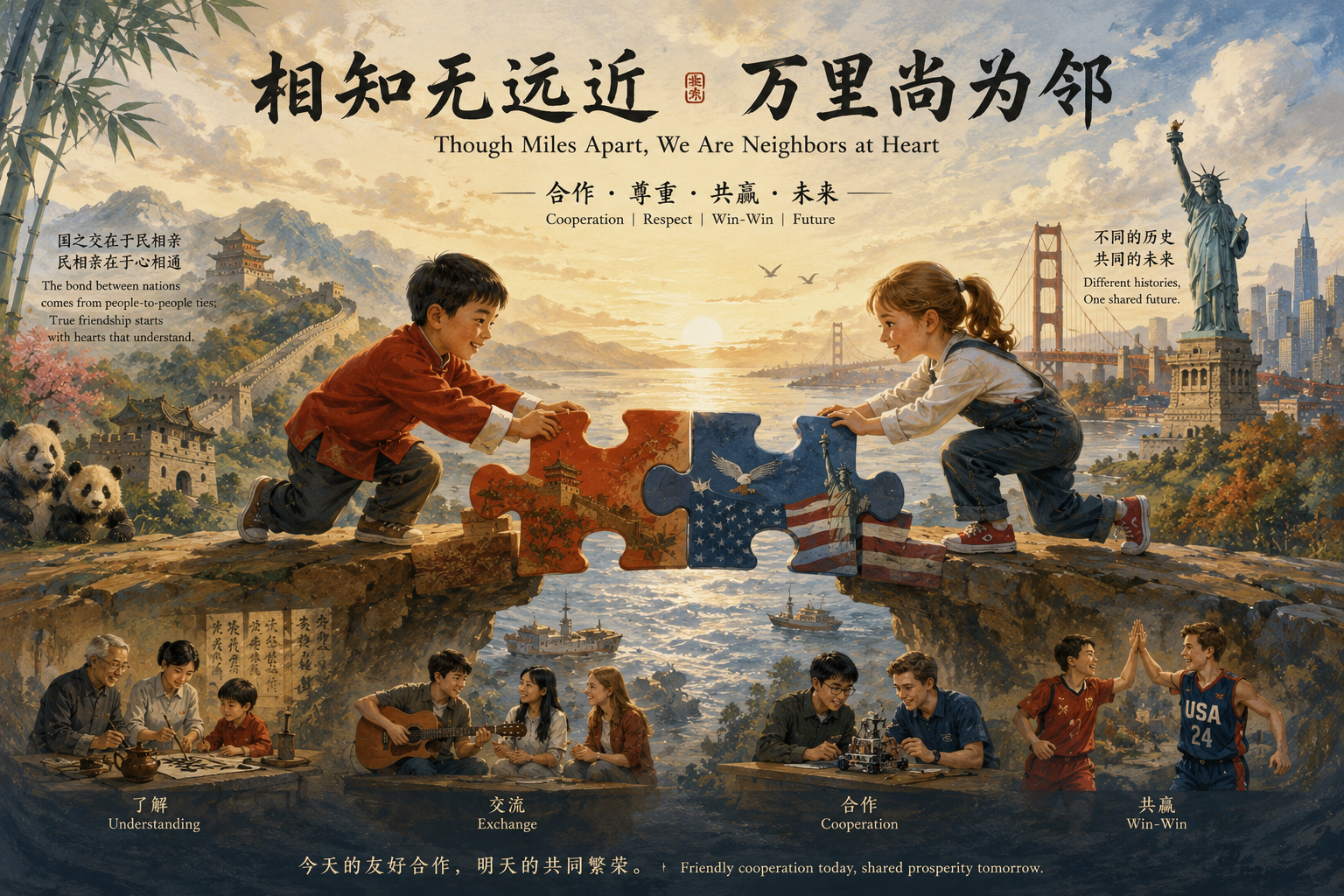
The structural tension between China and the West is driven by market forces, not ideological malice. Western firms’ technological moats are being breached by new Chinese entrants, reducing their monopoly rents. Yet lower prices brought about by competition generate global welfare gains—delivering affordable products to households worldwide. This mirrors the GDI’s principle of people-centered development: improving living standards across all societies. By serving Western consumers well—stabilizing prices, improving quality of life—the so-called “irreconcilable contradiction” may quietly dissolve.
Once both sides engage in escalatory countermeasures in pursuit of absolute security, it is the people of the world who inevitably suffer. No actor should deprive another of its legitimate right to development—this must become a global consensus.
China has no intention of “grinding the West under its heel” after its rise; instead, it signals its peaceful posture by trimming its own wings in security terms, much as Zeng Guofan demobilized the Xiang Army after defeating the Taiping Heavenly Kingdom to reassure the Qing court, or as Xiang Yu sent Liu Bang to the remote Bashu and Liu Bang burned the plank roads behind him to show no intent of returning.
While the United States insists on “peace through strength,” China offers what Washington claims to desire—full and undiluted relative security assurances. This resembles the Anglo-French appeasement of Germany before World War II: when concessions are given to the limit and Germany still tramples the bottom line, righteousness becomes self-evident.
If China repeatedly refrains from provocation and avoids security brinkmanship, and the U.S. still seeks confrontation, the moral clarity will be unmistakable. Should conflict erupt, China—backed by global sympathy and the New Nationwide System for mobilizing capacity—can recover from any early disadvantage caused by non-alignment and a restrained security posture.
In zero-sum or negative-sum security games, we need not force others to change; we only change ourselves, and through our transformation influence the environment. Coercing others to obey is the behavior of the arrogant and the self-centered.
Take Japan’s newly installed Prime Minister Sanae Takaichi, who declared that “a Taiwan contingency is a Japan contingency” and that such a scenario could trigger Japan’s collective self-defense. Her refusal to retract these misguided remarks is her affair; whether we are swayed is ours. As a subordinate figure with little historical awareness or strategic literacy, she is unworthy of overreaction.
International politics—an anarchy without “crimes of speech”—does not operate by punishing words alone. If she crosses the line in action, China will respond with firm measures—so that she understands she is not tugging at Hello Kitty’s whiskers but at the whiskers of the awakening Eastern tiger.
Thus, the GDI and the Global Security Initiative function like two wings of a bird or the two rails of a track: development is the centerpiece, security its guardian. Development has never been legitimately halted on account of speculative insecurity, for security is often psychological while development is tangible interests.
Security concerns only arise when material interests are harmed to the point that improper or violent remedies appear viable; one must not sacrifice foundational development rights because of imagined threats.
Security exists for development—steady, sustainable, mutually beneficial development. Ultimately, development resolves security. To win the goodwill of the West, China must avoid monopolizing benefits and instead ensure that the world shares in the fruits of growth—so that opportunities are equitably distributed, and common prosperity becomes truly global.
Follow Us
Great Unity and Ultimate Good(《大同至善》) is dedicated to tackling tough global challenges in the humanities and social sciences — intervening in crises, resolving complex problems, and designing strategies to address emerging issues.
Our organization operates in both non-profit and for-profit areas. For valuable public-interest projects or private collaborations, we work through our legal entity: Datong thinktank.
At Datong thinktank, we’re building a platform to attract and collaborate with outstanding talent—like ancient nobles who built “golden terraces” to invite the wise, or like strategists seeking heroes in their thatched cottages. In other words, we’re actively looking for brilliant partners and contributors.
Datong thinktank also provides foreign clients with due diligence services and open-source intelligence (OSINT) research.
Thank you for taking the time to follow and support us!
Domestic contact (China): WeChat ID — qiushuce
International contact: X (Twitter) — @qiushuce
Social media in China: WeChat Official Account / Toutiao — Great Unity and Ultimate Good(大同至善)
Official website: qiudatong.com



发表评论